The Rest of the Story

Well, it’s back. I’ve embarked on the #ClassicsChallenge2018 with a few friends and my brother along for the ride. All are welcome! The January assignment was Mystery/Suspense. In February, with Oscar Nominations top of mind, we’ll read a Book turned into a Movie. But for now, let’s talk Mystery.

During my Tween to Teen transition, I adored a good mystery. After all, I’d begun my exposure with The Bobbsey Twins and moved on to Nancy Drew and The Hardy Boys. But, after a while, I craved a little something more … grown up.

Enter the works of Phyllis A. Whitney and Victoria Holt. These were atmospheric tales of adventure and suspense, blended with Gothic tones, angst-ridden heroines and handsome, dashing men with names like Evan, Giles, Joss and Brandon. And they fascinated my younger, romantic self. Each book was set in some exotic or enticing location, too, adding to their attraction for a teenager living in Northern Indiana.

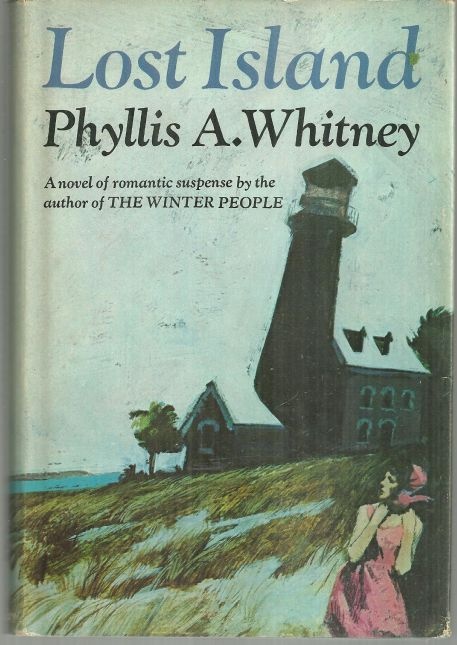
So, when it came time to select a Classic Mystery, what better than to pull out Phyllis A. Whitney’s Lost Island.” Yes, I did read it before. But it was … er … um … well at least 35 or so years ago. The publish date of 1970 makes it just shy of our group’s Classic status of 50 years old. But, a friend had given me a First Edition copy for Christmas, so I threw caution to the wind, grabbed a cup of tea and a cozy blanket, and settled on the couch with my #ClassicsChallenge2018 mystery.

Lost Island is set on a remote, apparently privately owned island off the coast of Georgia. And Whitney’s excellent use of imagery and description invites you to smell the sea air and feel the sand on your toes. Like Daphne du Maurier — who probably inspired Whitney, Holt and others of the time — the descriptions are often a bit over the top, There are some dated character descriptions and references  — not just ones found in gabardine pants or windbreakers. And, Lacey — our heroine for this novel — is a bit of a drama queen and always gazing off into the horizon. (Probably why I related to her and loved her so much in my Teen days!)

Quick plot summary (Caution for Spoilers). Lacey spent summers raised on her family-owned Hampton Island.  Her mom had run away from said island years before but her silhouette seems to throw a shadow over the island —  even though she married, moved to New York and has since passed away. Yet Lacey was always drawn back to Hampton Island … very clearly it was the handsome Giles Severn that was the attraction. But her cousin Elise was ever the rival.

But Elise is a head-strong girl and leaves the island to sow her wild oats before her eventual, expected settling down as mistress of the island named for her family, leaving Lacey and Giles to …. (you know this …) fall in love. Lacey of course gets pregnant. Elise returns to discover her destined husband — Giles — didn’t wait or pine for her. In fact, he’s no longer in love with her at all. She manipulates everyone, driving a wedge between Lacey and Giles, until Lacey runs away. Once Lacey is out of the way — as always expected — Giles and Elise get engaged. But … remember … Lacey is pregnant!

Elise and her mother, Lacey’s Aunt Amalie (see, everyone in these books has a unique name!) convince Lacey to give up the child and form a plan to make it seem that Elise, who has recently married Giles but is unable to bear children, is the baby’s mother. And, that’s where the story technically begins … 10 years later, Lacey is invited to visit the island by Elise, spends time with Giles — and her son Richard — and realizes what a devastating mistake she made all those years before.

Enter the mystery and suspense. There are attempts to scare her away, by someone. There are even attempts on her life. And as the dire nature of the “relationship” between Giles and Elise become apparent, Lacey’s feelings rev up and rekindle the romance and the love she denied for all these years. Eventually, as in all Whitney/Holt mysteries, someone dies. The story has many twists and turns before reaching the denouement. And the ending is a surprise.

I enjoy the atmospheric, melodramatic feel of these books. And I enjoyed Lost Island. The book — and others I read by the same author — sparked and continue to spark my creative energy and imagination. As a teen, I always imagined myself in the heroine’s place. I wanted to change my name to Lacey or Lyndall or Courtney or Skye. Something more unique and romantic than “Jennifer.”

But the books always seemed to end rather abruptly and I found myself curious as to the rest of the story. What happened to Lacey and Giles after the final page turn? To Courtney and Evan in The Golden Unicorn? (my FAVORITE Whitney novel) Heck, when I read du Maurier’s Rebecca, I wanted to know what happened to Maxim and the unnamed only known as Mrs. de Winter after the burning of Manderley.

I do that now, too … When endings come or people move on, out of my life or away, I wonder … what is the rest of their story? What happened after they walked out of my “movie?” What happened after goodbye or the burning of Manderley? What’s in the next chapter after they turn, walk off into the sunset or drive away? It’s not as though their lives stop after they leave my scene. What secrets don’t I know? What subtext did I miss? What happens next? What IS the rest of the story?

I’m curious that way. And I guess that’s why these Phyllis A. Whitney mysteries appealed to me as a teen and continue to appeal to me now. Exotic, romantic places and people fascinate me. Incomplete tales are so real. And though the pages of a book tell me what’s going on, when I close the book, I know there’s always more to the story.

Life is full of mystery and suspense … surprises and fascinating people. I don’t need Whitney or Holt or even Dan Brown to show me that. I just keep turning pages … not knowing what’s coming next …

— Jenni

Back to the Classics with Rachel

A few years ago, a friend shared with me his Classics Challenge The idea was to read books written no fewer than 50 years ago in select categories, which he assigned as the year progressed. I was very diligent the first couple of years but, I have to admit that I wavered a bit lately. Not sure where I am on the 2017 Assignments, Ron, but I’m back with Gothic Fiction/British Fiction/Woman Writer/Suspense/Classic Made Into A Movie.

Is that a category?

rachelI have wanted to read Daphne du Maurier’s My Cousin Rachel for some time. Not sure why I haven’t pulled it off the shelf before now. I adored Rebecca and have read it multiple times. Frenchman’s Creek intrigued me and I also liked both Mary Anne and Jamaica Inn. But when I saw this title in New Releases, I was confused … I quickly discovered it was the new movie release edition, featuring none other than Rachel Weisz of The Mummy and Runaway Train fame on the cover. (For those of you purests, the 1952 film starred Olivia de Haviland.) Now that I’ve finished the book, I have the new movie on my to watch list.

I adore gothic fiction with its eerie shadows, candlelight and hints of subtle machinations just out of my line of sight. As a teen, I read Phyllis A. Whitney and Victoria Holt with abandon. So, this novel had my name written all over it.

The plot is told in first person by 24-year old Phillip Ashley and is exceptionally well-crafted. You glimpse where it is going, but instead of a straight paved path to the denoument, you have one set in Cornwall in an undefined year with dirt laden roads and carriages, exotic plant life and the sound of the surf pounding against rock. At least, that’s the imagery that I imagined.

Like Girl On A Train, the story is told by an unreliable narrator. Phillip is naive and has led a sheltered life, raised by his much older cousin after both of his parents are tragically killed. No, we never learn what happened to them. But, when the tale begins, seven year old Phillip and cousin Ambrose (age 27) have just gone to see a hanged man. The tale trapped me right there.

So begins a gothic Daphne du Maurier tale. Her books are resplendent with vivid imagery and description. Every word selected with the intent to ensnare you and leave you questioning your senses. She was meticulous with this creation.

Phillip and Ambrose have lead a very solitary bachelor life somewhere in Cornwall sometime in the 19th Century. The author admits to choosing to be purposefully vague with time and location. Ambrose apparently has some health issues so he travels in the colder season. And during one of his trips abroad goest to Italy, meets a distant cousin of his, Cousin Rachel.

It is clear quickly that Ambrose is fascinated and drawn to Rachel. His letters to Phillip become less frequent. And Phillip, like a petulant child, takes great dislike to this interloper. As you can probably surmise, Ambrose eventually marries Rachel. Then, begins the intrigue. Ambrose falls ill, hinting in a hastily penned letters to Phillip that perhaps something is rotten in the state of Denmark … er … Italy. Phillip races to his aid only to find he is too late. Ambrose is dead. Rachel has shut up the villa and disappeared, and his only access to information is a seemingly sinister “lawyer-type” named Rainaldi, to whom Phillip takes an immediate dislike.

Now, strangely, Phillip and Ambrose — though cousins — bear a strong resemblance to each other. Just keep that in mind as the plot grows gothic-er.

Of course, Cousin Rachel asks permission to come visit Phillip, who is determined to hate her and malign her face to face. Encouraged by his childhood friend — the very wise Louise who is the voice of reason throughout the novel — he prepares to call her out. But, upon meeting her in a chilling scene set in her “boudoir” where it is uncertain if Cousin Rachel sees his face or the shadow of her former husband, Phillip immediately finds himself attracted to this woman … an attraction that turns rapidly from infatuation to possessiveness and jealousy.

Rachel charms everyone on the estate … everyone but Louise who glimpses something more sinister in her. But, she’s the only one. Now, I’m not one to malign a woman. Women are too quick to turn on each other. And Phillip’s obsession and possessive tone make it impossible to define beyond reasonable doubt of Cousin Rachel’s true motives. Is the atraction mutual? Is it genuine? Is there something spinning behind her brown eyes, her lace veil and well-tailored mourning attire? Hard to truly say for certain. But, less I give too much away, there is an inheritence, which dear cousin Ambrose neglected to provide to his wife. And Rachel captivates everyone like a clever spider weaving a web.

“But a lonely man is an unnatural man, and soon comes to perplexity. From perplexity to fantasy. From fantasy to madness.”

Cousin Rachel is fascinatingly crafted. Even Daphne du Maurier admitted her attraction and confusion regarding this chimera of a character. Is she wicked? Is she simply doing the best she can to survive in a male dominated world? Is she manipulating everyone? Does she genuinely care for Phillip? Was there a murder in Italy? Is Phillip sucker-punched or does he see love and intrigue where there is none? These are questions I leave to the reader to determine an answer to based on their own reading of the tale.

My Cousin Rachel will draw you into its suspenseful, darkly woven pages. Unlike Jamaica Inn, it is not overdone. At least I don’t see it that way. And, as I type with the movie soundtrack playing over my phone, I find myself very satisfied with the book. Oh, Phillip’s whining and self-centered outlook wore on me while Louise’s words ring with wisdom beyond her young years. But, these differing views served to blend the lines between what was real and what he thought was real.

“There are some women, Philip, good women very possibly, who through no fault of their own impel disaster. Whatever they touch, somehow turns to tragedy.”

But is any of the Tragedy Cousin Rachel’s doing … or does it occur in the mind of a spoiled, self-centered man who knows little about women with exception of their role in fulfilling his own whims and meeting his personal desires? Ah, therein lies the rub.

I happen to like characters like Rachel — women who refuse to be defined or dominated, who turn occurrences to serve them or their needs. Women who know how to work a room. Women who are clever, playing life like a chessboard. Women who leave you wondering exactly what they want and who they truly are. Like du Maurier, Ambrose and Phillip, I fell for her charms. But, like Louise Kendall, I watched fascinated as her actions played out with artful finesse.

And that is why My Cousin Rachel remains a classic tale that will leave you riveted and wondering until that final sentence and perhaps even afterward.

– Jenni


Oh the places you’ll go …

I’m re-reading one of my favorite books. The name doesn’t truly matter.  I believe reading is very personal and that a book invites us on adventure unique for each of us. How I experience a book and how you might experience the same one, well, that might be different. When we read, we let go of control and allow words to shape, create images and color our surroundings. How we experience a book is dependent on our personality, circumstances and where we are emotionally when we crack it open. I’ve re-read enough books to know that you can have a completely different experience another time through.

Now, I don’t re-read many books. I have too many new ones on my list! But there are a few that captivate me … that draw me in and keep me connected to them no matter how many books I read in the between times.

I received notification from Goodreads, the site I log my reads, want to reads and books read, that the final book in the installment would be released this week. I recalled how much I enjoyed the first two books last summer, sitting outside on my patio, savoring the pages as I soaked in some rays. These books had been discovered on a fluke. I’d been browsing the new release shelves at my local library when the title drew my attention.

I have to admit that I’m shallow when it comes to my media. An intriguing cover and catchy title are perfect bait.

Anyway … with a new release imminent, I decided to return to this well-loved tale. This time through, though, I wanted to own the Trilogy. And, as I’ve run out of shelf space and am trying to avoid additional clutter, I opted to download them onto my Nook. Thus my adventure in Prythian began anew.

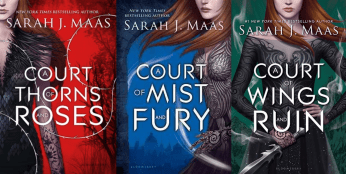
rosesIt’s funny. I remember fundamentals. I know where the story is heading and how it will end. But I find myself reading between the lines now. Looking for signs of things to come in book two and beyond. I see the characters differently when I re-read them. I cast them in my mind and watch the story unfold. Books are my own mental movies. Of course, I know things at this point I didn’t know the first time through. Yet, I’m still fascinated. I”m still drawn in as I delve into the characters, their relationships, their stories and their adventures. Perhaps I even project myself into the character of Feyre.

Why, you may wonder, re-read a book? You know how it will go. You know how it will end. Where then is the draw? Wouldn’t it be better to find something new and journey somewhere else?

I guess a good book is like a favorite vacation spot. You travel there again and again. But when you arrive, your pulse rate slows and you find ease and a sense of bliss. You can’t wait to get there. You walk the well-known beach and discover a view you missed before. Or, you simply find pleasure in re-tracing the path you’ve gone so many times and gazing at the view of the bay which you’ve seen year after year but still can’t get enough of.

For years, my family has traveled to Traverse City in August. We’ve stayed on the East Bay. We’ve unpacked our luggage in the same — or much similar — hotel room.  We’ve shopped at Bayside Market for seafood and this wonderful cherry chicken salad. We’ve journeyed by car — and boat — along the peninsula to see the same incredible views. We’ve enjoyed Thai Food, pizza and cheese, crackers & wine at our umbrella covered picnic table. Over the years, we’ve built sandcastles, played beach volleyball and walked a familiar trek morning after morning … year after year. As an “early riser, ” I’ve watched the sun ascend over the horizon with coffee in my hand … and for a time kids on my lap.  We’ve embarked on sunset cruises or jaunted out to Elk Rapids by boat. We’ve floated on many inflated plastic “oasis” and sipped everything from water to sodas, beers, and tropical cocktails — relying on a cabana boy (or girl) to keep us stocked so we didn’t need to climb off our floating paradise.

A favorite book can be like that. It’s a friend. It’s a vacation spot. It’s a loved one … someone or someplace you revisit over and over and over again even though you know the ending. It’s a place you genuinely like to go where you can relax, unwind, let go, and enjoy every time you travel there.

When I unpack in that Traverse City hotel room, I know that seven days hence I will repack my bags. Another year will go by before I return — perhaps more. The kids will be different … older. I will be too. It is never the same, this favorite vacation spot by the bay. Each year, despite the repeats, something is different. Yet, I find joy every single time.

I guess it’s the same as that book … I know where the tale is headed. I know there will be struggles and celebrations, love and loss. But how I experience it and the pleasure I find reading it, that is new every time I crack it open.

Oh the places I go, without a ticket, car or passport. A favorite book is a friend or a special place that I can’t wait to return to … even though I know what happens on that final page …

                                                                                                                              — Jenni

The Mystery of #ThrowbackThursday

Assigned by the #ClassicsChallenge2017 to read a children’s book, I opted for my one of my preteen favs: Nancy Drew. I have a few if the yellow 1960s-70s editions in my personal library. I’d hoped my daughter would read them one day, along with the Bobbsey Twins who also delighted me for many years. She wasn’t really interested in the “classic versions” of either of these books. There are, apparently, more modern editions of the titian-haired sleuth’s detecting.

lilac-inn

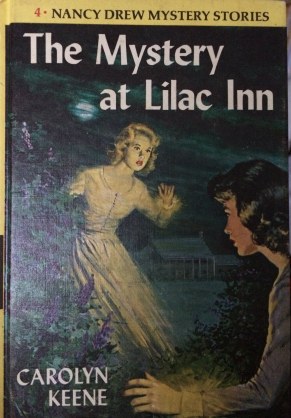
I chose The Mystery of The Lilac Inn, originally published — believe it or not — in 1931. And curled up under a blanket with a cup of tea in hand, this book was a delightful throwback to my foray into mysteries.

Nancy — as always — stumbles upon something that seems like a ghost and turns out to be nothing like what you think it might be when the adventure begins. Her canoe is overturned by a puzzling jostle, leaving her wet and bedraggled on a trip to visit her dear soon-to-be-married friend at Lilac Inn. No sooner does she arrive but, diamonds disappear, cabins mysteriously burn, a strange impersonator steals her charge-plate and secret rooms are discovered. Of course Lilac Inn seems to be Haunted and no one finds that at all surprising. Just the way things are in Nancy Drew’s world.

I think what I enjoyed most about Nancy Drew, Hardy Boys and Bobbsey Twin books is the cliffhanger at the end of every chapter. For a long time, I know I transferred that strategy into my own writing (and wished — wish? — to twist it into my own life too). Chapters always wrapped up with crashes of thunder, flashes of lightning, wicked villains wrecking havoc, Nancy or a friend hit on the head or exciting discoveries that encouraged the reader to turn that next page.  I have to admit that I secretly longed for these kind of exclamation point, exciting occurrences in my own life.

Nancy Drew mysteries always wrap up in Scooby-style. The darn titian blond (just what IS that color and who in the 30s had it naturally?) solved the crime in classic style while sporting some pink sheath dress and wrapping the culprit up neatly for local authorities. I’m so glad local authorities honored the insight of a young woman in the 30s! And that her Dad encouraged her and never seemed to be too concerned that his daughter was always getting roped into danger. These were never a straight-forward crimes either. The mysteries somehow generated more loose-ends than a string bikini and more characters that popped in and out than I could keep track of neatly. But somehow Nancy figured it out. Kudos and Bravo, I say.

But back to that Cliffhanger Chapter Closer thing. I think that was my favorite aspect of any Nancy Drew mystery. That writing method certainly made Nancy’s adventures  more compelling. Can you just imagine your own life including a Gasp! or a Hidden Passage! or a Kidnapping! or a Criminal Mastermind closing in!

Our daily lives don’t often include an Exclamation Point! when we wrap up a chapter. There are times I wish it did though. I’m adventurous, like Nancy. And it sure would add a little more excitement to the day-to-day routine. Pretty sure Nancy never got bored or restless ….

Maybe that’s why after all these years, I still enjoy Nancy Drew.

 — Jenni


Dear Lady Chatterley … It’s Me Not You

First assignment of #ClassicsChallenge2017 was a banned book. Cool right? A chance to read something that once upon a time was forbidden. I selected DH Lawrence’s Lady Chatterley’s Lover, “privately published” in Italy in 1928 but denied to the masses. When Penguin Books tried to release it in 1960, it was subject to an obscenity trial. (Double coolness!) So, when it officially hit the shelves, the PR alone helped it sell 3 Million copies, billing it as a notorious story about a physical (and emotional) relationship between a working class man and an upper-class woman. Class integration and explicit descriptions of sex as well as the use of then “unprintable words” made it the Fifty Shades of its time.

Despite the hype, I was left unsatisfied. But it wasn’t you, Lady C. I’m sure it was me. I wanted a little faster pace. Perhaps the timing was off. I’ve heard it said the attitude of the reader affects the response to a book. We all bring our life and our current state of mind into our reads. And in the slower pace of this current season of my own life, I found myself impatient with you. All your moping and whining turned me off. Oh, I know you aren’t happy. But, when you meet Oliver, it takes you so long to reignite your flame that I stopped caring. Maybe I’m unfeeling, but by Chapter 10, I really wanted to smack you. Bring on the action and the sex already! (Um, maybe I should have given this an R rating.) Anyway, the foreplay in this book teased me but left me unsatisfied and bored.

reading-a-bookWith Fifty Shades, I got average writing, but there was action. I’m not demanding and I don’t require instant gratification. I like to exercise my imagination. Yet despite initially interesting characters and some well-crafted observations that resonated, the tedious writing desperately called for a good editor. It left me with a plot that plodded until the romance was gone. Hence the break-up. I returned you Lady C, unfinished, to the Library.
Quick overview: Good opening paragraph (check it out!) Story begins with a woman raised to understand and appreciate her own sexuality. Dad wants his two daughters to enjoy a forward-thinking view of love, sex and womanhood. Then, the war happens and Constance, (the eventual Lady C) who has been sowing her wild oats in Germany, comes home and marries Sir Clifford Chatterley. He’s then shipped off to the War and comes home in pieces.

Fortunately — or unfortunately for Constance — they put the pieces back together but he is paralyzed from the waist down and … impotent. Newlyweds Constance and Clifford move North — away from the beauty of Yorkshire to his estate located in an industrial area. Clifford is full of himself and decides he will become a great writer, surrounding himself with people who give him props. Due to his injury, Constance struggles with his physical neglect. But it’s his emotional unavailability that breaks her further. Constance is bored and completely unstimulated. She meanders through her days, loses weight, and falls into depression.

Enter blue-collar guy Gamekeeper Oliver Mellors and we find out why the book was banned. The two breach that segregation of classes with a frank, never before so graphically presented sexual relationship. Constance violates class barriers AND further shocks readers by discovering she cannot live a satisfying life with the mind alone. She must also be alive physically. DH Lawrence flaunts the dangerous idea that real love can only be forged with a physical relationship — not simply one of the mind.

I recognize our generation prefers a fast-paced story. But I’m not typically like that demanding. And I didn’t mean to rush you, Lady C. I needed less moping and angst to connect with your story. Maybe, I should take you out again and try you as a Beach Read. Perhaps lounging and soaking in the warm rays of the sun in my bathing suit would make you more intriguing then you are in the dreary mid-Winter. Perhaps we will meet again. After all, you satisfied 3 Million readers in the ’60s, so there must be more to you than I discovered during our month together.

Because I could get no satisfaction and we just didn’t connect, I left you. My fault, clearly. Me, not you. I wish you the best.

                                                                                                                        — Jenni


It’s a Mad, Mad, Mad, Mad Looking Glass World

We want life to make sense. Yet it doesn’t.

We believe in Cause and Effect, clinging to the notion that our existence will follow a logical path. Yet it won’t.

We rise in the morning with a plan that the day will occur just so. We base our expectations on past experiences and our understanding of life and the people who travel with us. Yet events unwind and unravel anyway.

We speak and expect a certain, logical response … and we are surprised when something unexpected occurs instead.

One moment you’re laughing and sharing stories with a friend. family member or coworker. Then, without warning you are covered in Humpty Dumpty’s shattered shell, certain only moments before he was secure up on that wall. But now, despite great effort, all the king’s horses and all the king’s men can’t seem to put Humpty Dumpty — or that relationship — back together again.

One moment, you are off to a simple Tea Party. Then, somehow, you are surrounded by mad people and never get a cup of tea at all.

One moment, life is simple and the project is under control. The next moment the Red Queen is yelling for your head.

different-personOne moment, you know exactly where you going and who you are. Then, you slip down a Rabbit Hole, chasing a White Rabbit who carries a pocket watch and is somehow chronically late to everything, and you find yourself interrogated by a Caterpillar. You follow directions, drinking and eating things as you are told. But you are stuffed into a teapot and lost anyway, discovering you don’t know who you are because somehow you have changed.
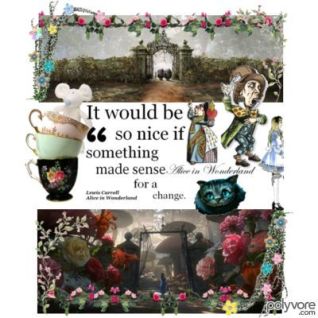
We seek logic, order and control. But, life is a grand, unpredictable mystery full of players who go off script much too often. It’s an ongoing Adventure to keep you moving, with good, bad, evil, sadness, loss, surprise, despair, excitement, tears, boredom etc etc. Life is anything but logical and predictable, no matter how we try to make it so. It’s full of impossibilities and rabbit holes and mixed up messages and conversations that make no sense and occurrences that are anything but what they seem. And when you find yourself wondering where you are going, what the heck went wrong or what road to take now, you realize that the Cheshire Cat was correct after all. If you don’t know where you are going than it doesn’t truly matter what road you take to get there.  made-sense

And that’s when I find that no matter how I look at it, it’s a Mad, Mad, Mad, Mad Looking Glass World and I am Lewis Carroll’s Alice, stating that it would be ever so nice if something made sense for a change.

Have you ever read Alice Through the Looking Glass – or Alice in Wonderland for that matter? Wonderland was created in 1865, while the Looking Glass sequel was published in 1871. They have long been considered classic children’s tales but few children actually read them anymore. Many have seen the Disney-inspired Alice cartoon or the more recent live action adventures with Mia Wasikowska and Johnny Depp. But it all began with a story told to entertain a little girl.

But did you know that these two little books have inspired hundreds of subsequent works, including a seemingly endless number of books, films, TV series, comic books, manga art, graphic novels, and even role-play and video games? We find fascination in Nonsense.

This doesn’t surprise me. I love everything Alice. Her imagination, cleverness, witty repartee with Dinah, Hatter, Cheshire, and Absalom the Caterpillar — and the manner in which she deals with the numerous creatures — make her compelling. I admire her adventurous spirit as well as her unquenchable, limitless curiosity which enable her to venture beyond the constraints dictated to her by society, rules, Queens and authority figures who make the rules. She won’t be told or limited.

Why all this Alice, you ask? Perhaps I should have begun by saying this was a book review. My year began reading Alice Through the Looking Glass. And as I read, I related to life in Wonderland … a world full of nonsensical occurrences with moments where nothing mad3makes sense or follows an expected, logical order. After all, we are all Mad … the Best people are you know. And our world is strewn with flowers who criticize and call you a weed and oysters gullible enough to be misled by a clever walrus. And despite warnings, the Jabberwocky looms ahead, a beast we don’t understand but battle all the same.

Somehow, amidst the Nonsense, we can find Hope. We can embrace the Impossible and find Adventure in the Wonder happening around us. And we will continue to make our way down the path. I guess that’s why I love Alice so much. Her curiosity and sense of adventure keep her from giving up when she gets lost and give her the courage to love the Bandersnatch and battle the Jabberwocky.

Don’t try to dissect Alice. There’s truth in nonsense. Pick up the book or jump through the Looking Glass and see where it takes You … Jenni

Alice In Wonderland Impossible Quote Cute Tim Burton Tumblr Follow Alice In Wonderland Cheshire Cat

On “The Notebook” and Books The Make Me Cry

A friend of mine suggested I read Nicholas Sparks’ The Notebook. I recoiled immediately. See, I don’t read books that make me cry. I read books that take me on fantastic adventures, epics and fantasies, science fiction and faerie tales, mysteries and historical fiction, biographies and non-fiction (occasionally) and classics. But I draw the line at books that cause tears.

But, there I was at the used bookstore in Caseville, a selection of reading options before notebookme, and I found myself browsing tales written by Nicholas Sparks. My father has read everything Sparks has written, which encouraged me a bit. Before I realized it, I reached out for the movie-covered paperback version of this book that was the New York Times bestseller for over a year.

It sat in my car for a while, teasing me and daring me to open it. So, this holiday season when my emotions and sentimentality were already flaring, I decided it was time. So, there I was on the day after Christmas settling into my chair with the book in hand.

I was drawn in quickly. The book quotes poetry … Whitman, Keats and others. I adore Whitman. I don’t memorize poetry often, with the exception of James Whitcomb Riley. But To A Stranger and Captain, My Captain have always moved me and inspired my spirit. Early in the story, Noah quotes him. A guy who reads and quotes poetry in a book written by a guy?  I was hooked.

This is thy hour, O Soul, the free flight into the wordless,

Away from books, away from art, the day erased, the lessons done,

Thee fully forth emerging, silent, gazing, pondering the themes thou lovest best,

Night, sleep, death and stars.

There is a lyrical quality to the writing, not sure if this is true of all Sparks’ books, but this one truly captivated my heart as the story is poetry in itself. There are beautifully crafted thoughts and images that take me to New Bern, NC and create a very vivid impression of the house and the porch. The words connected me to the characters in an artful way.

In terms of plot, the story begins towards the end: a man in love daily sharing words he preserved about a life led in a Notebook he has written that he reads daily to the woman he clearly adores. (Another turn on – a guy writing a journal with a love story in it too!) Anyway, as you turn the pages, you think you know who they are, but you aren’t quite sure.  You are hopeful though, so you keep reading. And you find out that this woman (Spoiler Alert Here as if there is anyone but me who hasn’t read this book or seen the movie) has been stricken with Alzheimer’s Disease.

Though I anticipated it, I almost abandoned the book here. You see, I lost my Grandfather to this horrible disease nearly 20 years ago and it still affects me, the marks red as though struck only days ago. It’s an awful disease. However, I read on.

I immersed my sentimental, romantic spirit in a beautiful, timeless love story. I found myself dog-earring pages and notebook-soulsunderlining quotes that touched me, re-reading them over and over before moving on. Such love. Such passion. Such struggle. And there are details along with emotional content applied with brush strokes to a canvas in a way I rarely experience.

Then, as I drew nearer to the end of the story, it happened. The tears began to flow. Even as I think of the final pages, I get choked up. I guess Noah had it right when he said “Poets often describe love as an emotion we can’t control, one that overwhelms logic and common sense.” But in this book, something rare and beautiful was created. Something that can survive time, distance, separation and a horrible sickness simply because two souls connected.

In a time where connections and relationships of all types are difficult and challenged — when people are all charged up — this little book was a reminder that love is strong. That love is patient and understanding. That separation is not always goodbye forever but a farewell ’til souls meet again — or until the time is right to reunite those souls.  Friends, family members, children, acquaintances who live far away, loved ones … it doesn’t matter. Souls connected are just … Connected for always.

So, The Notebook made me cry. But, I’m glad I read it anyway.

If you haven’t read it and you can prepare yourself for surges of emotion and poetry, well, I challenge you to pick it up. It’s a classic tale of love and it won’t take you long to reach those final pages.

But it will take you on a wonderful adventure and remind you that passion is ageless AND timeless.

                                                                                                                               — Jenni

Valley of the Grey aka Fifty Shades of Dolls

Dolls … a way for a girl to find security. Dolls … a friend to help a girl to lay down cares and get rest. Dolls … a source of playfulness and energy to get through the day. Dolls … something to cling to when you find your way to the top and discover what no one tells you … that it’s more fun at the bottom than at the summit.

I’m not talking Barbie or American Girl when I talk of “Dolls” here. Sure, these Dolls come in a variety of colors … green, blue, red and yellow. But they aren’t found at a toy store. In this Valley, these dolls come in prescription bottles and are more commonly referred to as stimulants, depressants, diet pills, and sleeping pills.

Assigned by the #ClassicsChallenge2016 to read a trashy novel, I made a wise selection when I chose Jacqueline Susann’s Valley of the Dolls.  It was a stirring and fascinating read with characters who possess a vibrancy that made them real to me. And the book, 50 years after its publication date, absolutely stands the test of time. It’s sexy and raw. I’d planned to pick it up at the library but when I stopped by Barnes & Noble and found one solitary copy, I didn’t hesitate … grabbing it and opening to the first words … a poem actually … to see if it was something I wanted to add to my bookshelf.

I was drawn in.

“You’ve got to climb to the top of Mount Everest to reach the Valley of the Dolls,” the poem began. “It’s a brutal climb … but the last thing you expected to find was the Valley of the Dolls. You stand there, waiting for the rush of exhilaration … but it doesn’t come … You’re alone and the feeling of loneliness is overpowering…The elements have left you battered, deafened, sightless — and too weary to enjoy your victory.”

I will admit though that like the readers of the Fifty Shades series I was tempted to wrap it in a brown paper cover. I mean, everyone’s heard about this book wrought with drug addiction and a very frank look at sexuality — it was described as “decades ahead of its time.” I’ve seen the 1980’s mini-series (with Lisa Hartman, Veronica Hamill, Catherine Hicks, David Birney and all those popular stars of the era) so I had some idea where it would go. But … what a great ride.

VoftheD

The cover is by no means subtle. And it hasn’t been updated since the initial publication. It still features that pink color background, cut out pills and the faces of the three main characters peeking thru — their eyes and hair styles so very 1960 with expressions wary yet strong, and no apologies for their ambitions, desires, choices and behavior..

“They say I’m difficult. They say I’m drunk even when I’m not. Sure, I take dolls – I’ve got to get some sleep. I’ve got to get up at 5 o’clock in the morning and ‘Sparkle, Neely, sparkle!'” – Neely O’Hara

There are a lot of dolls in this book. Characters pop them like candy to serve their emotional issues and help them get through their days and nights.

Valley of the Dolls is NOT Fifty Shades of Grey … thank goodness. Valley of the Dolls breathes life into characters that are so meticulously defined as to seem real. Valley of the Dolls has a feminist tone to it. And the women in it are fighters you can’t help but cheer for, more than slightly ahead of their 1945 start date.

Released in 1966, the book was an overnight success, becoming the year’s bestselling work of fiction. Since that time, it has sold 30 million copies (well, 30 million and ONE now), making it one of the bestselling books of all time.

What earns it that “bestselling” rank? Both the writing and the characters draw you in. The story is descriptive and interesting, keeping you turning the pages with enthusiasm and dread too, since you know the girls are going up and then down. You cheer for them. And you suffer with them too.

You first meet Anne, a smalltown, wealthy East Coast beauty with class who comes straight off “the boat” into New York City, determined to make her mark and experience life. She finds quick success and attracts a rich guy whose desperate to marry her. But Anne wants to hold out for real love. She finds the guy  … gets the guy … loses the guy … gets the guy back but then tries to control the guy —  her big mistake. And that plunges her from the top into that damn Valley.

In the early chapters, Anne befriends sweet Neely who lives in the same shabby apartment building. She’s a vaudeville artist originally known as Ethel Agnes O’Neill who coins her last name after spending a long evening reading Gone With The Wind. Scarlett and Neely have a lot in common, though Neely’s character is shamelessly and transparently based on Judy Garland. Neely is the first character to experience sex and share it unabashedly with all the readers (it’s Trash, remember). Neely rises to super-stardom and becomes vicious and arrogant at her peak — plunging into the psych ward but clawing her way out again with destruction in her wake.

And then we meet Jennifer — drawn clearly from the image of fascinating Marilyn Monroe — an ambitious blonde insomniac whose intelligence may be overlooked but whose beauty and buxom figure never will be. Jennifer’s sex life runs the gamut. A product of a bad home life and a needy, greedy mother, all Jennifer truly wants is to find someone to love her and have babies. And she knows how to do that. “Remember there’s only one way to own a man,” she tells Anne. “By making him want you.” And when she finds the right guy … well, that would be telling and I’m not gonna spoil it for you. But I’m sure you can guess by now that this book doesn’t have a Disney tone or a Disney ending.

The supporting characters and their adventures on the pages of this book are 3D real. You see echoes of Dean Martin, Frank Sinatra and Ethel Merman on the pages. And you find yourself cheering for Neely to find success, hoping Anne will finally have the nerve to love out loud, and longing for Jennifer to get the guy, find happiness and have that baby. And, when they start taking the pills … well … it’s devastating.

Jennifer takes the Red … the Seconals … to sleep. And the Blue to end the pain.

Neely takes the Green at first … to lose the weight … and then adds Scotch to the mix with a variety of “Dolls” to help her find strength to wake and face the gruelling, unglamourous real Hollywood life.

And Anne … sweet Anne. She holds out the longest. She’s the strongest of them all. But her love for Lyon does her in and she ends up with the Red too. To get her through.

Uppers, downers, pills to cope and pills to sleep. Plenty of sex. Glimpses of life at its real peak … before these characters find themselves lost in the Valley of the Dolls.

Read it. It’s Trashy. But Valley of the Dolls is a classic that stands the test of time. I just heard Madonna, J Lo and Anne Hathaway may be starring in a remake of the film …

— Jenni


The Woman In White

I like the color white.

I like to wear white and variations of white like ecru, off white and cream. I like to lay out my white lace tablecloth and watch my white battenburg lace curtains blow in the breeze. I appreciate a well pressed white button down shirt on a man. And I’ve always admired white Victorian tea gowns worn on stage and screen.

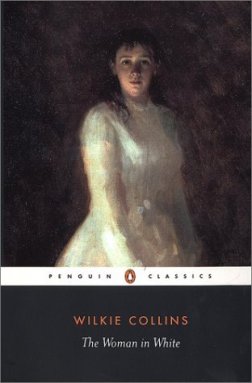
I guess that’s what drew me to read Wilkie Collins’ The Woman in White. I’m a sucker for a good title or cover art. When Ron’s Classic Challenge urged me to “get mysterious,” my immediate thought was Sherlock Holmes or Agatha Christie.  But I’ve read those recently. And when I think “mystery,” I envision something dark. Another reason why the suggestion to read a mystery with someone conjuring a woman in white intrigued me.

And I’m very happy to say it didn’t disappoint. It was a true page turner and I didn’t want to put it down!

I was drawn in at the first encounter with the mysterious title character. I wasn’t certain for a while if she was a ghost or real, so compelling was Collins’ description.

womand in whiteThen there’s the actual story “telling.” I’ve never read a book told by so many points of view that actually mastered such a craft. Collins’ employed several narrators to accurately tell his tale, probably due to the fact that the book was originally published as a serial tale in a magazine. A challenge Collins took at the urging of his friend Charles Dickens. Each narrator had his or her own tone of voice that was very distinctive. Such a clever tactic too!

The story is complex and one doesn’t want to give away too much when reviewing a mystery. But there is the requisit hero — a poor art teacher who falls in love with the woman under his tutelage. Her smart and very likable sister informs him she’s pledged to many another and great sadness ensues for all three characters. Then there is the fiance, presenting likability but showing his true colors as deceitful and callous, and his protagonist friend — and nasty wife — who are just truly wicked. Other characters fill in the novel with a little man introduced in the early pages — an almost castaway early character who becomes quite a hero toward the end of the novel himself.

Oh how the woman in white suffers. Oh what dastardly deeds take place. Oh what a challenge it is to untangle the webs. Oh what fun it was to read.

Despite its length of 550 pages, it read quickly. Collins achieved great success with this novel. But it is also very clear that he was immensely proud of it … Author of The Woman in White is engraved on his tombstone.

I like the color white.The Woman In White was a fascinating read. Collins is a masterful story-teller. The book engages the imagination 150 after its original publication. And her story and character kept me reading late into the night.

— Jenni