

Assigned by the #ClassicsChallenge2017 to read a children’s book, I opted for my one of my preteen favs: Nancy Drew. I have a few if the yellow 1960s-70s editions in my personal library. I’d hoped my daughter would read them one day, along with the Bobbsey Twins who also delighted me for many years. She wasn’t really interested in the “classic versions” of either of these books. There are, apparently, more modern editions of the titian-haired sleuth’s detecting.
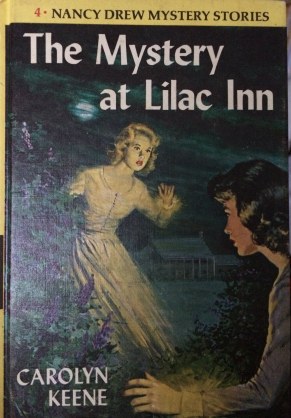
I chose The Mystery of The Lilac Inn, originally published — believe it or not — in 1931. And curled up under a blanket with a cup of tea in hand, this book was a delightful throwback to my foray into mysteries.
Nancy — as always — stumbles upon something that seems like a ghost and turns out to be nothing like what you think it might be when the adventure begins. Her canoe is overturned by a puzzling jostle, leaving her wet and bedraggled on a trip to visit her dear soon-to-be-married friend at Lilac Inn. No sooner does she arrive but, diamonds disappear, cabins mysteriously burn, a strange impersonator steals her charge-plate and secret rooms are discovered. Of course Lilac Inn seems to be Haunted and no one finds that at all surprising. Just the way things are in Nancy Drew’s world.
I think what I enjoyed most about Nancy Drew, Hardy Boys and Bobbsey Twin books is the cliffhanger at the end of every chapter. For a long time, I know I transferred that strategy into my own writing (and wished — wish? — to twist it into my own life too). Chapters always wrapped up with crashes of thunder, flashes of lightning, wicked villains wrecking havoc, Nancy or a friend hit on the head or exciting discoveries that encouraged the reader to turn that next page. I have to admit that I secretly longed for these kind of exclamation point, exciting occurrences in my own life.
Nancy Drew mysteries always wrap up in Scooby-style. The darn titian blond (just what IS that color and who in the 30s had it naturally?) solved the crime in classic style while sporting some pink sheath dress and wrapping the culprit up neatly for local authorities. I’m so glad local authorities honored the insight of a young woman in the 30s! And that her Dad encouraged her and never seemed to be too concerned that his daughter was always getting roped into danger. These were never a straight-forward crimes either. The mysteries somehow generated more loose-ends than a string bikini and more characters that popped in and out than I could keep track of neatly. But somehow Nancy figured it out. Kudos and Bravo, I say.
But back to that Cliffhanger Chapter Closer thing. I think that was my favorite aspect of any Nancy Drew mystery. That writing method certainly made Nancy’s adventures more compelling. Can you just imagine your own life including a Gasp! or a Hidden Passage! or a Kidnapping! or a Criminal Mastermind closing in!
Our daily lives don’t often include an Exclamation Point! when we wrap up a chapter. There are times I wish it did though. I’m adventurous, like Nancy. And it sure would add a little more excitement to the day-to-day routine. Pretty sure Nancy never got bored or restless ….
Maybe that’s why after all these years, I still enjoy Nancy Drew.
— Jenni
 With Fifty Shades, I got average writing, but there was action. I’m not demanding and I don’t require instant gratification. I like to exercise my imagination. Yet despite initially interesting characters and some well-crafted observations that resonated, the tedious writing desperately called for a good editor. It left me with a plot that plodded until the romance was gone. Hence the break-up. I returned you Lady C, unfinished, to the Library.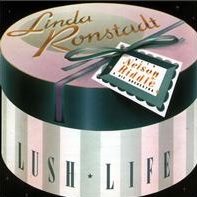


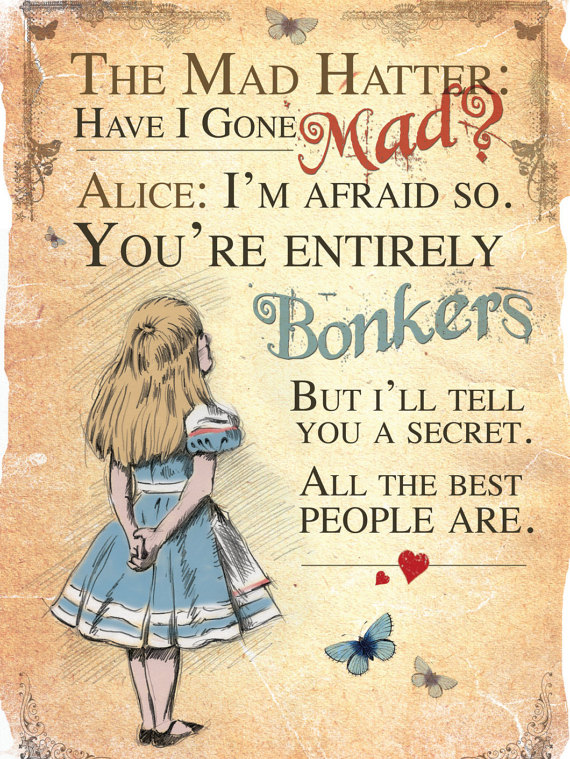
 One moment, you know exactly where you going and who you are. Then, you slip down a Rabbit Hole, chasing a White Rabbit who carries a pocket watch and is somehow chronically late to everything, and you find yourself interrogated by a Caterpillar. You follow directions, drinking and eating things as you are told. But you are stuffed into a teapot and lost anyway, discovering you don’t know who you are because somehow you have changed.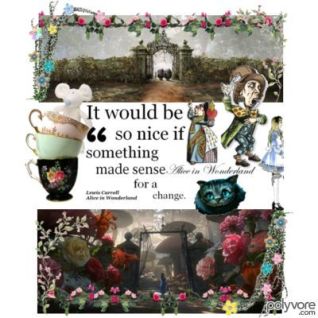
 makes sense or follows an expected, logical order. After all, we are all Mad … the Best people are you know. And our world is strewn with flowers who criticize and call you a weed and oysters gullible enough to be misled by a clever walrus. And despite warnings, the Jabberwocky looms ahead, a beast we don’t understand but battle all the same.

 me, and I found myself browsing tales written by Nicholas Sparks. My father has read everything Sparks has written, which encouraged me a bit. Before I realized it, I reached out for the movie-covered paperback version of this book that was the New York Times bestseller for over a year.
 underlining quotes that touched me, re-reading them over and over before moving on. Such love. Such passion. Such struggle. And there are details along with emotional content applied with brush strokes to a canvas in a way I rarely experience.

 my own little corner ... by jenni